
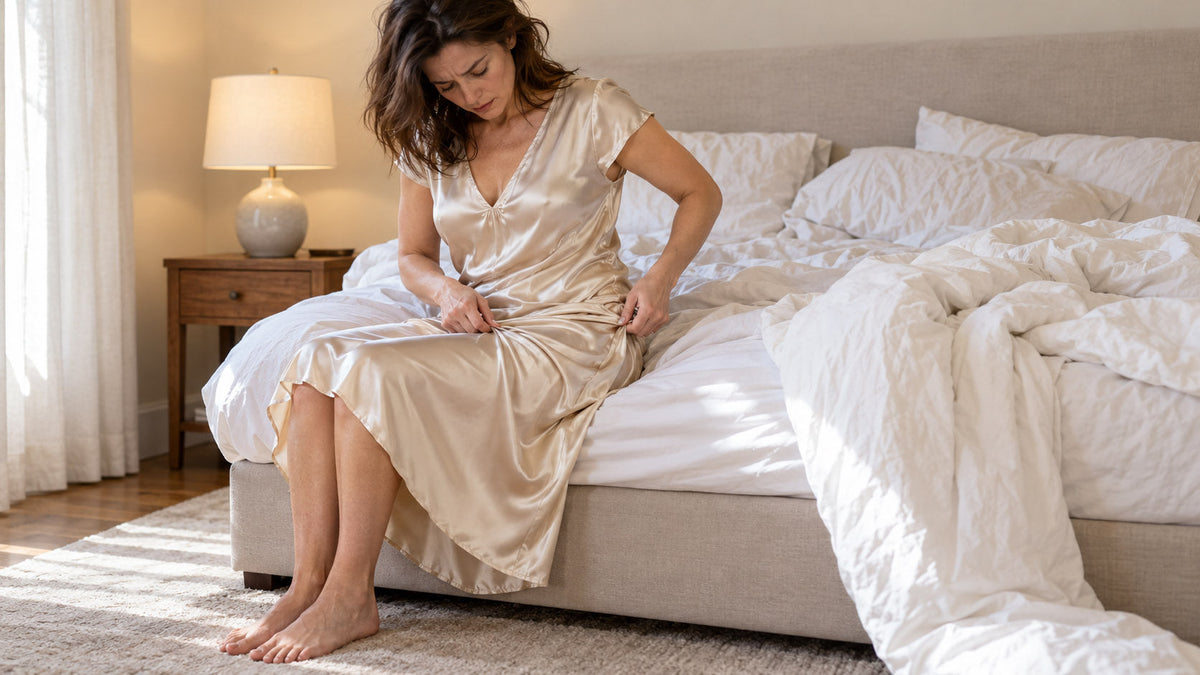
A silk nightgown that rides up, twists around the body, or clings to the skin by morning is not simply a minor inconvenience — it disrupts sleep and turns what should be a comfortable garment into a frustrating one. Most of these issues are predictable and preventable through the right choice of cut, fit, and length. Understanding why each problem happens makes finding a nightgown that avoids them considerably more straightforward.
Riding Up: Why It Happens and How to Prevent It

A nightgown rides up primarily because of two factors: friction and movement. As you move during sleep, the fabric between your body and the bedding moves in two directions simultaneously. If the hem is not long enough or heavy enough to maintain its position against this movement, it migrates upward.
Shorter nightgowns are more prone to riding up simply because there is less hem weight to keep the fabric in place. However, length alone is not the full answer — a very long nightgown on a restless sleeper can still rise significantly if the cut is too narrow or the fabric too lightweight.
The most effective preventive measures: choose a nightgown with adequate ease through the hips — a garment that is too narrow restricts movement and forces the fabric upward as you stretch or turn. Opt for a slightly longer length than you think you need; a hem that falls at the knee tends to stay more consistently in position than a mid-thigh hem. A heavier momme weight (19 to 22) gives the fabric more body and a greater tendency to fall back into position after movement.
Twisting: Why Silk Nightgowns Rotate Around the Body

Twisting is a distinct problem from riding up. Where riding up is about vertical migration, twisting involves the garment rotating around the torso — waking up with the side seam at the front, or the hem wound around the legs.
Twisting occurs most commonly in bias-cut nightgowns. The diagonal grain that gives bias cuts their fluid drape also means the fabric responds readily to rotational forces — each time you turn in bed, the garment has a slight tendency to turn with you rather than remaining stationary against the bedding.
An A-line cut or a nightgown with a more structured construction is far less prone to twisting, because the fabric does not cling as closely to the body and has more ease to move independently. For a full comparison of how cut affects movement during sleep, see Bias-Cut vs A-Line Silk Nightgown.
For restless sleepers, the most practical solution is to choose either a short nightgown with less fabric to rotate, or a fuller-cut longer style with enough ease that the garment moves without wrapping tightly around the body.
Bunching: What Causes Fabric to Gather at the Waist or Hips

Bunching at the waist or hip area happens when there is excess fabric in one place that cannot distribute evenly. This is different from twisting — it is a localized accumulation of fabric at a single point rather than a full rotation of the garment.
The most common cause is a nightgown that is too large overall. A well-fitted nightgown with the correct amount of ease moves smoothly with the body; an excessively large one has fabric that folds and gathers as it moves. The solution is typically to size more accurately — including checking length, not just bust and hip measurements.
A second cause is a design with a defined waist seam or gathering at the waist. While these create a shaped silhouette when standing, they also create a point where fabric collects as you move. A straight or A-line cut with no waist seam tends to distribute movement more evenly down the length of the garment. For a full fit guide, see How Should a Silk Nightgown Fit?
Static and Clinging: Causes Specific to Sleep
Silk can develop static charge in dry environments, particularly during cooler months when indoor air humidity is low. Unlike the static issues that occur with a silk dress during the day, the clinging that happens during sleep involves prolonged contact between silk and bedding material across many hours.
Synthetic bedding materials — polyester sheets, microfiber duvet covers — generate significantly more static charge in contact with silk than natural fiber bedding. If your nightgown consistently clings in the morning, checking the composition of your sheets and duvet cover is the most effective first step. Switching to cotton or linen bedding dramatically reduces static between silk sleepwear and bedding.
Additionally, a silk nightgown worn in a very dry, heated room is more prone to static than one worn in a more humid environment. Running a humidifier during winter months, where feasible, reduces static charge in both bedding and sleepwear simultaneously.
Choosing a nightgown with slightly more ease also reduces clinging — a garment with more space between the fabric and skin is less able to sustain a static charge against the body.
If you are choosing a new nightgown specifically to avoid these problems, the range of pure silk nightgowns with A-line cuts and comfortable ease is a practical starting point. The right cut and fit prevents most of these issues before they begin.
Frequently Asked Questions
Why does my silk nightgown ride up every night?
Usually because it is too short for the amount you move during sleep, too narrow at the hips (restricting movement and forcing fabric upward), or too lightweight to maintain its position. Try a longer length or a style with more ease at the hips.
Why does my nightgown twist around my body while I sleep?
Most often because it is bias-cut — the diagonal grain responds to rotational movement during sleep. An A-line or fuller-cut style is much less prone to twisting because the fabric moves independently of the body rather than following it closely.
Why does my silk nightgown cling in the morning?
Static charge between silk and synthetic bedding is the most common cause. Switching to cotton or linen sheets significantly reduces this. A dry heated room also increases static — a humidifier helps. Choosing a nightgown with more ease also reduces clinging against the body.
Can a nightgown be too loose?
Yes. Excessive fabric gathers and bunches rather than distributing smoothly. The correct amount of ease is enough to move comfortably without restriction — not so much that the garment folds on itself. If a nightgown bunches significantly at the waist or hips, it is likely too large for your proportions.
