
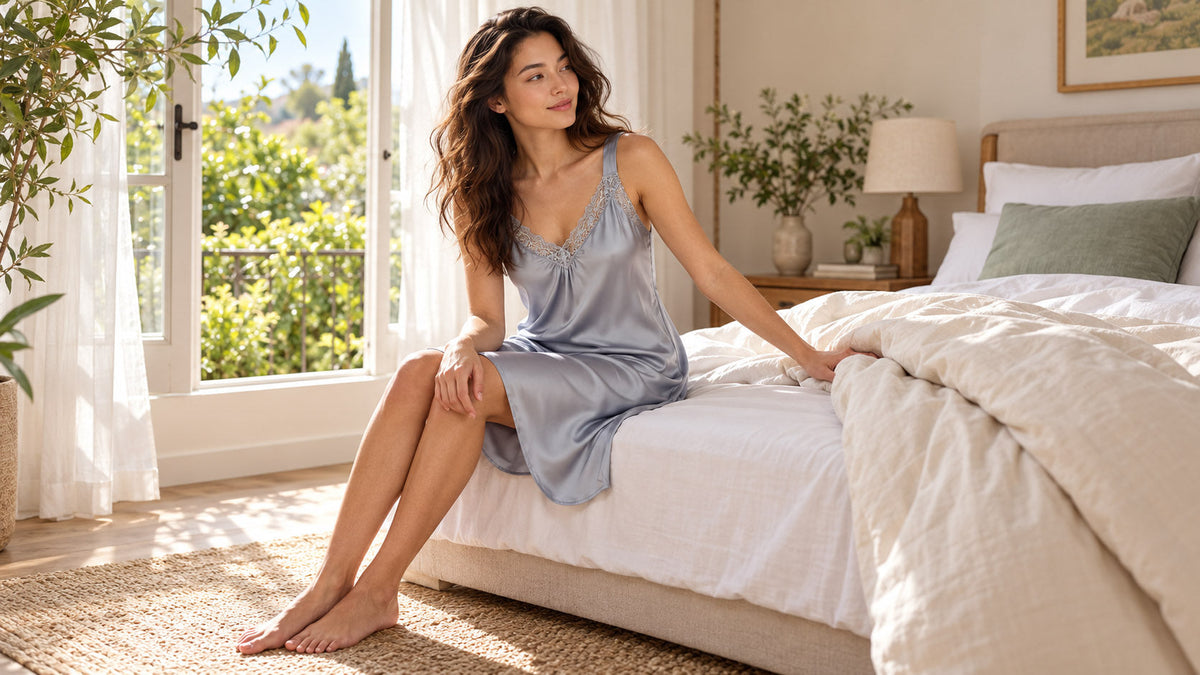
Choosing sleepwear when you sleep warm is not simply a matter of picking the least fabric — it also involves understanding how cut, fit, and construction affect airflow and whether a garment stays comfortable through the night. Silk's natural properties are relevant here, but the specific design of the nightgown matters just as much as the fiber.
Why Silk Performs Well in Warm Conditions
Silk is a natural protein fiber with a structure that allows air to circulate more freely than many synthetic alternatives. It does not trap heat in the way that polyester or nylon tend to, and it absorbs small amounts of moisture without feeling immediately damp against the skin. For warm sleepers, this combination makes silk a genuinely better choice than most synthetic fabrics.
What silk does not do is actively cool the body — it is not an engineered cooling fiber. Its advantage is in what it does not do: it does not hold heat close to the body the way a dense weave or synthetic material tends to, and it does not feel immediately stifling when the temperature rises.
These are the natural properties of the fiber, not medical claims. Silk will not address underlying causes of excessive warmth during sleep — anyone experiencing persistent disruptive symptoms should seek advice separately from their choice of sleepwear.
Which Nightgown Cut Works Best for Hot Sleepers?

Length
The simplest adjustment is length. A short or knee-length nightgown exposes more of the legs to the air than a midi or floor-length style. More exposed skin means more direct contact with cooler air from the bedding and the room — a meaningful difference in comfort on a warm night.
For a detailed comparison of how different lengths perform, including their effects on movement and temperature, see Long vs Short Silk Nightgown.
Sleeve Style
Spaghetti straps or wide-strap sleeveless styles expose the shoulders, upper arms, and back to the air — the areas of the body where heat is most effectively released. For hot sleepers, a sleeveless style in a short length provides the maximum combination of minimal fabric and maximum airflow.
Long sleeves in any fabric add warmth at the arms, which is welcome in cooler environments but counterproductive for warm sleepers. Cap and short sleeves offer a useful compromise — slightly more coverage than bare shoulders, but minimal added warmth.
Fitted vs Loose in Warm Conditions

A tightly body-skimming nightgown — particularly a bias-cut style with minimal ease — reduces the space between fabric and skin. This means less air circulates between the garment and the body, which can feel warmer than a slightly more relaxed fit.
An A-line cut or a style with some ease through the body allows more air movement between the fabric and skin. For hot sleepers, a nightgown with a relaxed or flared silhouette is generally more comfortable than one designed to cling closely.
Paradoxically, a very loose or excessively full nightgown can also feel uncomfortable in warm conditions — large amounts of fabric bunching around the body trap air rather than letting it circulate. The ideal for warm sleepers is a relaxed but not excessively full fit.
Does a Silk Nightgown Cling When Damp?
Silk absorbs moisture to a degree, but it can begin to cling against the skin when it becomes more significantly damp. A nightgown that fits closely against the body is more likely to feel clingy in this condition than one with more ease through the silhouette.
For warm sleepers who experience this, choosing a style with slightly more ease — and opting for a higher momme weight that has more body and is less translucent when damp — reduces the likelihood. A shorter style also reduces the total surface area of fabric in contact with the body.
Nightgown vs Pajamas for Hot Sleepers

A silk nightgown in a short or knee-length style with spaghetti straps or wide straps generally runs cooler than a silk pajama set with long trousers, simply because it uses less total fabric and leaves more skin exposed.
That said, a camisole and shorts pajama combination achieves a comparable level of airflow and may be preferred by those who want separate leg coverage. The relative coolness of each comes down to the specific style — a long nightgown versus a short pajama combination is not a fair comparison.
For women who sleep particularly warm, the women's silk sleepwear at The Silk Avenue includes styles suited to warmer conditions — shorter lengths, relaxed cuts, and sleeveless constructions designed with airflow in mind.
Frequently Asked Questions
Is silk cool to sleep in?
Silk does not trap heat the way many synthetic fabrics do, making it more breathable and comfortable in warm conditions. It absorbs light moisture without feeling immediately damp. It does not actively cool the body but performs better than most alternatives in warm environments.
Which silk nightgown is best for summer?
A short or knee-length nightgown with spaghetti or wide straps, in a relaxed or A-line cut, offers the best combination of minimal fabric and good airflow. A 16 to 19 momme weight is light enough to feel insubstantial and cool without being fragile.
Does a silk nightgown cling when you perspire?
It can, in conditions of significant dampness. Choosing a style with more ease rather than a body-skimming cut, and a heavier momme weight for more fabric body, reduces the likelihood of clinging during sleep.
Is a silk nightgown or pajamas better for hot sleepers?
A short, sleeveless silk nightgown generally uses less total fabric than a long-trouser pajama set, making it slightly cooler. However, a camisole-and-shorts pajama combination is comparably cool. The specific style and length matters more than the garment type alone.
