
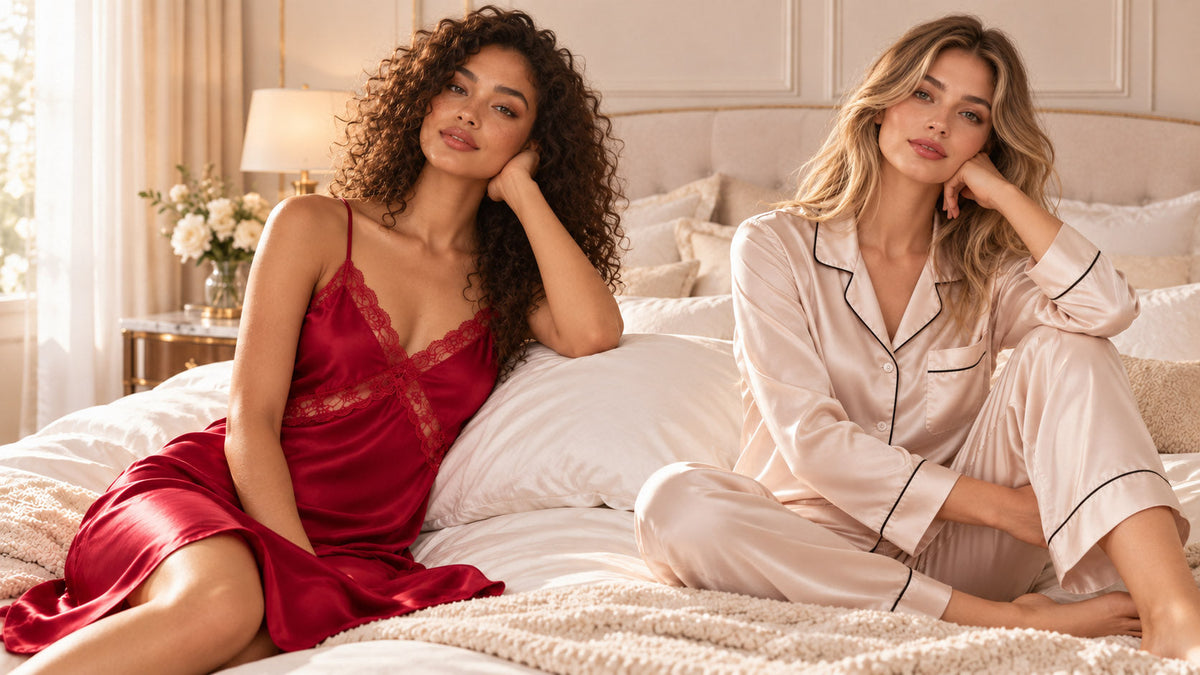
A silk nightgown is the better choice if you dislike waistbands, sleep hot or travel light. A silk pajama set is the better choice if you sleep cold, want full leg coverage or like to lounge at home without a robe. Both offer the same material, but they are different garments with different strengths. The choice is largely about how you sleep, how you move, and what you prioritize in your sleepwear.
Key Differences at a Glance
The table below compares a silk nightgown and a silk pajama set on the seven factors that matter most for sleep.
| Factor | Silk Nightgown | Silk Pajama Set |
|---|---|---|
| Waistband | None | Elastic or drawstring at waist |
| Leg coverage | Partial to full (by length) | Full leg coverage |
| Freedom of movement | High — no separate waist piece | Good — waistband may press |
| Modesty | Lower (depends on length and cut) | Higher — covered top and bottom |
| Temperature | Cooler (less fabric overall) | Warmer (more fabric) |
| Ease of dressing | One garment — faster | Two pieces — more steps |
| Travel packing | Compact | More volume |
The Waistband Question
The waistband is, for many people, the most decisive difference between a nightgown and pajamas. A pajama set's waistband — even a well-designed elastic one — applies some pressure around the abdomen during sleep. For most people this is entirely comfortable; for others, particularly those who sleep on their stomach or who are sensitive to any constriction, even a soft waistband is disruptive.
A nightgown eliminates this entirely. With no separate waist piece, there is nothing to press, roll, or shift at the midsection through the night. For anyone who finds waistbands uncomfortable during sleep, a nightgown is the natural solution. For those who prefer full leg coverage or need more warmth, pajamas are often the more comfortable choice.
Freedom of Movement and Sleeping Positions

A silk nightgown moves as a single continuous piece of fabric, with no seam or transition at the waist to restrict or bunch. A silk pajama set offers excellent freedom of movement at the legs, with a loose-fit trouser that covers fully without restricting movement. Here is which style suits each way of sleeping:
- Stomach sleepers: a nightgown, because there is no pajama waistband pressing into the abdomen.
- Frequent position changers: a nightgown, which turns with the body as one continuous piece.
- Cold sleepers: a pajama set, whose full leg coverage is a significant practical advantage in cool environments.
- Active sleepers: a pajama set or a longer nightgown in a fuller cut, as a short nightgown may ride up during the night.
Pajama trousers are less likely to ride up or twist than a longer nightgown. However, a short or knee-length nightgown in a fuller cut can also stay in position well. Cut and fit matter more than garment type alone. For an overview of how length affects sleep performance, see Long vs Short Silk Nightgown.
Temperature: Which Is Cooler?
A short to mid-length nightgown generally runs cooler than a pajama set with long trousers. It uses less total fabric — no trouser leg, no separate top seam at the waist — and leaves more skin exposed, which makes it a natural fit for hot sleepers.
However, a silk pajama set with short trousers, or a camisole-and-shorts combination, can be equally cool while offering more coverage and modesty. The comparison is not simply nightgown versus pajamas — it also involves the specific style and length of each. A long nightgown is not necessarily cooler than a camisole-and-shorts set: length and total fabric coverage are what matter most.
Nightgown or Pajamas: Which Should You Choose?
Choose a silk nightgown if you:
- Dislike waistbands: no separate waist piece presses or rolls through the night.
- Sleep hot: less fabric and more airflow keep you cooler.
- Travel often: a single garment packs compactly and doubles as a slip dress.
- Value simplicity: one piece is faster to slip on.
Choose a silk pajama set if you:
- Sleep cold: full leg coverage adds warmth.
- Want more modesty: top and trouser cover you completely.
- Lounge at home: you can answer the door or relax all morning without a robe.
- Move a lot at night: trousers are less likely to ride up.
Modesty, Lounging and Shared Spaces
A silk pajama set is inherently more modest than a nightgown of equivalent coverage. The top-and-trouser combination covers the legs completely and is the more practical choice in shared living situations, for answering the door, or for lounging throughout the house without adding a robe.
A nightgown paired with a matching robe creates comparable coverage — but it does require an additional layer. For a relaxed morning at home without extra garments, a pajama set has a practical edge.
Travel and Packing

A single nightgown typically takes up less space than a two-piece pajama set. For travel where packing volume matters, a lightweight nightgown has a clear advantage. Both styles travel beautifully in silk — the fabric packs without unnecessary bulk and releases minor creases with hanging.
Slip-style and bias-cut nightgowns in particular can double as casual slip dresses or cover-ups in informal settings where a pajama top and trouser would be inappropriate. This versatility is one of the practical advantages of a well-made silk nightgown over a pajama set.
Key Takeaways
- Comfort: a nightgown suits those who dislike waistbands; pajamas suit those who want full leg coverage.
- Temperature: a short nightgown runs cooler, though a camisole-and-shorts set can match it.
- Modesty: a pajama set covers more and needs no robe for lounging.
- Travel: a nightgown packs smaller and doubles as a slip dress.
- Fit: length and cut matter as much as the garment type itself.
For women considering both options, the silk nightgown collection at The Silk Avenue can be compared directly alongside the pajama collection, making it easier to assess which silhouette and construction best suits your sleeping style.
