
The word silk covers a broader range of fabrics than most people realise. Different types of silk fibre, different weave structures, and different finishing processes produce fabrics that look and feel quite different from one another — even when they are all genuinely, authentically silk. Understanding which type of silk is best suited to sleepwear, and why, allows you to make a more informed choice than fibre content alone provides.
The Fibre First: Mulberry Silk vs Other Silk Types

Before considering weave structure, the silk fibre itself matters. Mulberry silk — produced by Bombyx mori silkworms fed exclusively on mulberry leaves — is the highest-grade silk available and the standard for quality sleepwear. It produces the longest, finest, most consistent filaments, which translate into a fabric that is smoother, more uniform in sheen, and more durable than silk from other sources. Tussah silk, produced by wild silkworms, is coarser, less lustrous, and less smooth against the skin — it has its own qualities suited to different applications, but is generally not the preferred choice for sleepwear that will be in contact with the skin all night.
Grade 6A Mulberry Silk
Within mulberry silk, grades exist that reflect the quality of the filament. Grade 6A is the highest classification, indicating the longest, most uniform, and least defect-prone filament. Grade 6A mulberry silk produces the smoothest, most consistently lustrous fabric and is the appropriate standard for quality sleepwear. Lower grades are not necessarily poor quality — they are simply less consistent in filament length and surface uniformity, which affects both the feel and the long-term appearance of the fabric.
Weave Structure: How It Changes Everything

The same mulberry silk fibre woven differently produces dramatically different fabrics. The weave structure determines the surface texture, the drape, the opacity, and the way the fabric moves. For sleepwear, the three most relevant weave types are charmeuse, habotai, and crepe.
Silk Charmeuse
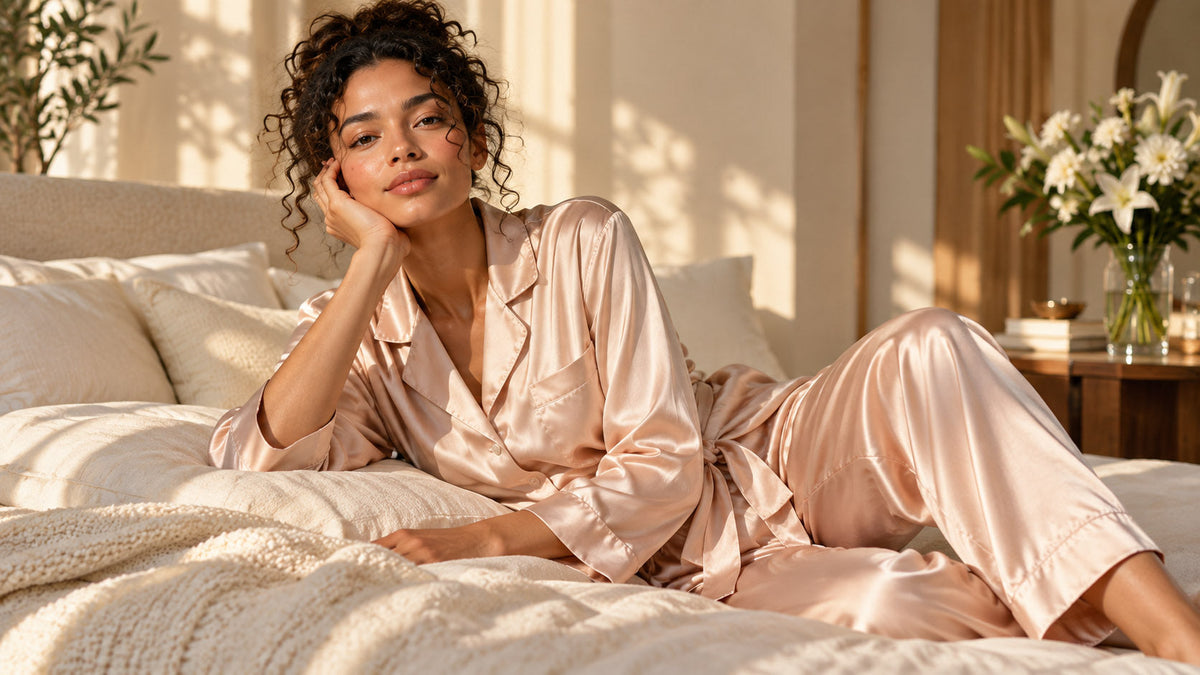
Silk charmeuse is the most common fabric for quality silk sleepwear and, for most purposes, the best choice. It is woven using a satin weave — the same structure that gives satin its glossy surface — which means the warp threads float over multiple weft threads to create a smooth, reflective face on one side and a more matte, slightly textured reverse. The result is a fabric with a beautiful sheen, an exceptionally fluid drape, and a smooth-against-the-skin surface that is highly suited to sleepwear worn in direct contact with the body. Charmeuse drapes fluidly with movement, clings lightly without gripping, and photographs with a depth of sheen that polyester satin cannot replicate.
Silk Habotai
Habotai — also called China silk — is a plain-weave silk fabric that is lighter, softer, and less lustrous than charmeuse. It has a uniform matte finish on both sides, a lighter, more flowing drape, and a softer hand than charmeuse. For lightweight summer pajamas or for women who prefer a less shiny, more understated fabric, habotai is an excellent choice. Its lighter weight makes it more suited to warm conditions, and its plain weave gives it a more relaxed aesthetic than the dressed surface of charmeuse.
Silk Crepe de Chine
Silk crepe de chine has a slightly textured surface — a very fine, even crinkle created by the crepe twist of the weft threads — that gives it a matte, understated finish with a subtle depth. It is more opaque than charmeuse or habotai at equivalent weights, drapes well, and has a more relaxed, contemporary aesthetic than the glossy surface of charmeuse. For women who prefer a less reflective fabric that still has the full performance qualities of mulberry silk, crepe de chine is a strong option for sleepwear.
Is Silk Satin the Same as Silk Charmeuse?
These terms are often used interchangeably, and the distinction is subtle but real. Silk satin refers to any silk fabric woven in a satin weave structure — it describes the construction. Silk charmeuse is a specific fabric: a satin-weave silk with a particular weight and finish that has become the standard for quality sleepwear. Both share the glossy face and matte reverse characteristic of satin weaves. In practice, when a silk pajama set is described as silk charmeuse, it typically refers to a high-quality, mid-to-heavy weight satin-weave mulberry silk — precisely the fabric most women are looking for.
What to Look for on a Label
When assessing a silk pajama set by its fabric specification, the ideal label reads: 100% mulberry silk, with a momme weight of 19 or 22mm. Grade 6A is a further quality signal worth noting when present. The fabric type — charmeuse, habotai, or crepe — tells you about the surface and drape, and is a matter of preference rather than a quality hierarchy. What matters most is the fibre (100% mulberry silk), the grade, and the momme. For a complete guide to choosing the right set across all these criteria together, the article on how to choose a high-quality women's silk pajama set brings every variable into one practical framework. For the momme-specific comparison, the dedicated guide on the best momme for silk pajamas covers every weight option in depth.
The Recommendation

For most women choosing a silk pajama set for everyday sleepwear, 100% mulberry silk charmeuse in 19 momme is the combination that delivers the best balance of surface quality, drape, breathability, and durability. It is the industry standard for good-quality silk sleepwear — and for sound reasons. If a lighter, more understated fabric is preferred, habotai or crepe de chine at 16 to 19 momme are excellent alternatives. The fibre quality (mulberry, grade 6A) matters more than the weave structure choice — get the fibre right, and the weave is a question of personal preference.
