
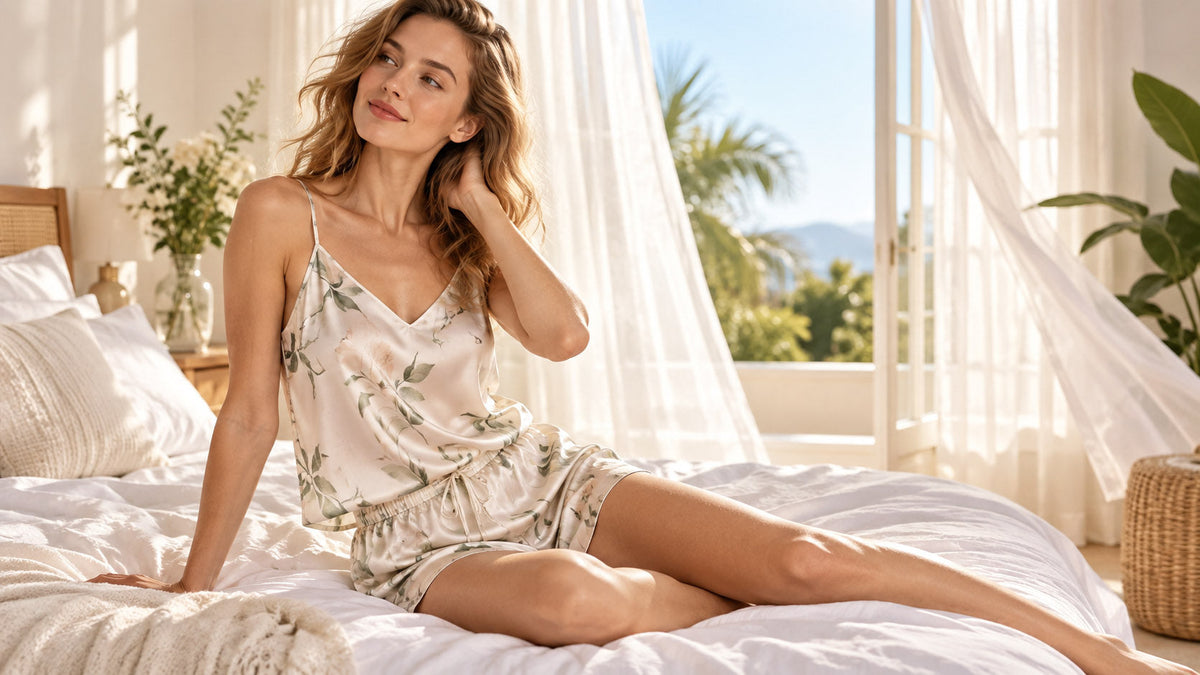
For hot sleepers — people who consistently wake up warm, perspire during the night, or struggle with overheating in bed — the choice of sleepwear fabric has a direct and measurable effect on sleep quality. The question of whether silk pajamas are a good solution for this specific challenge is one worth answering carefully, because the answer depends on understanding what silk actually does thermally, and what it does not do.
Why Hot Sleepers Often Sleep Worse
Overheating during sleep disrupts the natural temperature drop that the body requires to maintain deep sleep stages. When body temperature rises, sleep becomes lighter and more fragmented — the sleeper may wake fully or simply move through shallower cycles without recovering the rest they need. The fabric in direct contact with the skin plays a meaningful role in this: fabrics that trap heat and moisture against the body accelerate and sustain the overheating that disrupts sleep. Fabrics that breathe and wick moisture away do the opposite.
What Silk Does for Hot Sleepers

Breathability
Silk is a naturally breathable fabric — its fine, tightly woven fibres allow air to circulate between the fabric and the skin in a way that synthetic fabrics do not permit. Unlike polyester satin, which creates a barrier that traps heat, silk allows airflow and prevents the heat accumulation that builds in non-breathable sleepwear over the course of the night. This is why a silk pajama set consistently feels cooler at 2am than it did at 10pm — the fabric does not retain heat in the way synthetic alternatives do.
Moisture Management
Silk is a moisture-wicking material — it moves perspiration away from the skin surface and allows it to evaporate rather than holding it against the body. This is one of the most practically significant properties for hot sleepers, who produce perspiration during the night even without visible sweating. A fabric that keeps the skin surface dry throughout the night contributes meaningfully to thermal comfort — damp skin in contact with retained moisture feels warmer than dry skin, regardless of ambient temperature.
Natural Thermoregulation
Silk does not simply cool — it regulates. This is the distinction between silk and actively cooling synthetic fabrics designed for athletic wear. Silk responds to body temperature dynamically: when the body is warm, the fabric allows heat to dissipate; when the body cools (as it naturally does in the early morning hours), the fabric provides a small amount of insulation. For hot sleepers who overheat in the first half of the night but feel cool in the second, this regulation is exactly what is needed.
What Silk Does Not Do
Silk is not a cooling technology. It does not actively lower body temperature or produce a chilling effect the way moisture-activated cooling fabrics do. For sleepers in extremely hot conditions — very high ambient temperatures with no air conditioning — silk will not solve the overheating problem on its own. In those conditions, room temperature management (airflow, a cooler duvet, ambient cooling) is required alongside breathable sleepwear. What silk does is remove the contribution of the sleepwear itself to the overheating problem — which is often a larger factor than sleepers initially realise.
The Best Silk Weight for Hot Sleepers

Silk fabric is measured in momme (mm) — the heavier the momme, the denser and heavier the fabric. For hot sleepers, a lighter momme weight — typically 16 to 19 momme — is preferable to heavier options. Lighter silk has more airflow, less thermal mass against the body, and a more fluid drape that sits less heavily against the skin. A 22-momme silk pajama set is an excellent choice for year-round or cooler-weather use; for consistently warm sleepers and summer conditions specifically, 16 to 19 momme performs best.
Long or Short Pajamas for Hot Sleepers?

Coverage is a relevant consideration for hot sleepers. A silk pajama set with shorts and a short-sleeve or sleeveless top provides less thermal mass against the body and more skin exposure for cooling than a long-sleeve, full-length set. Both styles work well for most hot sleepers, but those who overheat specifically through the legs and arms may find that a short set makes a more noticeable difference. For more on this choice, the guide on long vs short silk pajamas covers the full comparison.
Silk vs Cotton for Hot Sleepers
This comparison is relevant here because cotton is the traditional recommendation for hot sleepers. Fine cotton is breathable and does not trap heat; it is a genuine improvement over synthetic fabrics for warm-weather sleeping. Silk outperforms fine cotton for hot sleepers in two specific areas: moisture management (silk wicks and releases moisture faster than cotton, which absorbs and holds it) and thermoregulation (silk responds to body temperature rather than simply ventilating). For the detailed side-by-side comparison of both fabrics across all sleep conditions, the article on silk vs cotton pajamas covers every dimension.
The Verdict for Hot Sleepers
Silk pajamas are an excellent choice for hot sleepers — not because they are the coolest possible fabric in absolute terms, but because they are the fabric that best manages the combination of heat, moisture, and temperature variation that characterises warm-night sleeping. The key is choosing the right weight (16 to 19 momme), the right cut (shorter styles if coverage is the issue), and ensuring the fabric is genuine silk rather than polyester satin, which will make the overheating problem worse rather than better. For hot sleepers who have tried everything else, a genuine silk pajama set is typically the adjustment that makes the biggest difference.
