
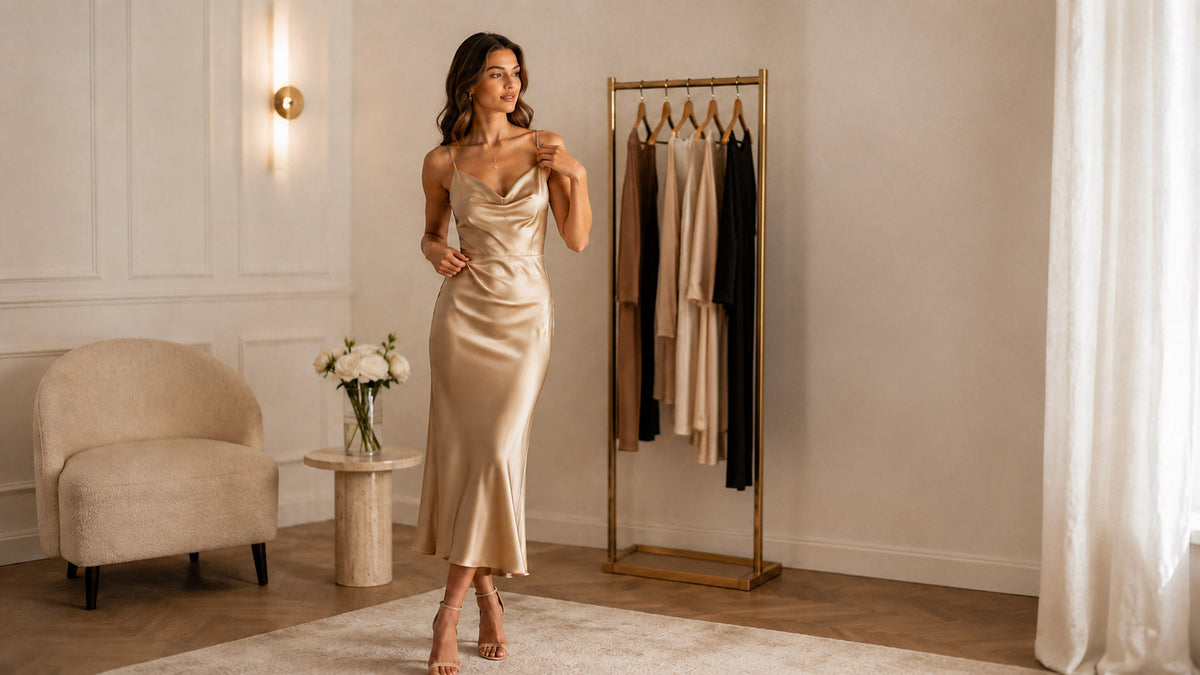
Fit is the single most important variable in how a silk dress looks and feels. A well-fitted silk dress is one of the most effortless garments a woman can wear; a poorly-fitted one — regardless of the quality of the silk, the beauty of the print, or the elegance of the cut — reads as wrong in a way that is immediately visible. Understanding how a silk dress should fit, and what specific fit issues to look for and address, transforms the experience of buying and wearing silk.
The General Principle: Drape, Not Cling

Silk is a fluid, draping fabric — its natural behaviour is to fall away from the body in smooth, uninterrupted lines rather than to grip or stretch against it. This means that the correct fit for a silk dress is not the same as the correct fit for a fitted jersey dress or a structured woven garment. A silk dress that fits well has what is called positive ease — a small amount of additional room beyond the precise body measurements — which allows the fabric to drape naturally rather than pulling or clinging.
If a silk dress is pulling horizontally across the hips, the bust, or the shoulders — creating drag lines in the fabric — it is too small. If it is billowing out of control or losing its silhouette entirely, it is too large. The target is a smooth, uninterrupted fall of fabric from the shoulder or bust downward, with the silhouette visible but not constricted.
How to Assess Fit at the Shoulder

For silk dresses with shoulder seams, the shoulder seam should sit precisely at the edge of the shoulder — at the point where the arm begins. A shoulder seam that falls down the upper arm means the dress is too large through the upper body. A shoulder seam that sits toward the neck means the dress is too narrow through the shoulders and will restrict arm movement and create pulling across the back.
Slip dresses and spaghetti-strap styles, which have no shoulder seam in the traditional sense, should sit smoothly across the chest without pulling the front down or gaping at the back. Adjust strap length where possible to achieve this — most silk slip dresses have adjustable straps for exactly this reason.
How to Assess Fit at the Bust

The bust is the most critical fit point in a silk dress. Because silk drapes rather than stretches, a dress that is too small through the bust will pull the fabric across the chest, creating horizontal drag lines and causing the neckline to distort. There should be no pulling, no gaping, and no horizontal lines across the fullest part of the chest.
At the same time, a slip dress or bias-cut style should not gap dramatically at the front when you lean forward or reach upward. If the front neckline falls significantly away from the body in those movements, the dress may be cut for a smaller bust and will require adjustment at the neckline to work correctly for your shape.
How a Silk Dress Should Fall Through the Body

From the bust or the natural waist downward, a well-fitted silk dress falls smoothly and continuously without clinging to any specific area or breaking in horizontal lines. There should be no pulling across the hips or the seat. For bias-cut styles in particular — which are designed to skim the body — there will be some contouring, but this should feel smooth and deliberate rather than tight.
Significant pulling across the hips in a bias-cut style indicates that the dress needs to be a size larger. The relationship between a bias-cut silk dress and the body is precise: the bias grain of the fabric is designed to give a specific amount with movement, and when the fit is correct, it feels remarkably comfortable. When it is too small, the bias ceases to give in the way it was designed to, and the dress pulls and twists.
The Hemline and Length

Silk dress lengths are not arbitrary — the hemline is part of the silhouette, and it should land at a flattering point for your specific proportions. A midi hem that sits at the widest point of the calf, rather than just below or just above it, can visually shorten the leg. A maxi hem that drags on the ground loses the clean line that a slightly elevated floor-length hem creates. When trying a silk dress, stand at your full height in the shoes you will most often wear with it — the hemline assessment is not meaningful in bare feet if the dress will be worn with heels.
Buying the Right Size
When in doubt between two sizes in a silk dress, the general recommendation is to size up rather than down. The draping nature of silk means that a dress with a little extra ease will simply fall more loosely and beautifully. A dress that is a size too small will pull, distort, and feel uncomfortable across extended wear. For bias-cut styles specifically, where the fabric is designed to give with the body, sizing up by one size — and allowing the bias to provide a fitted effect through the fabric's natural behaviour — is nearly always the more comfortable and visually successful approach. For more on cling and how to manage it, the guide on how to stop a silk dress from clinging has practical solutions. And for guidance on building a complete look around the dress once you have the fit right, the silk dress styling guide covers every occasion.
