
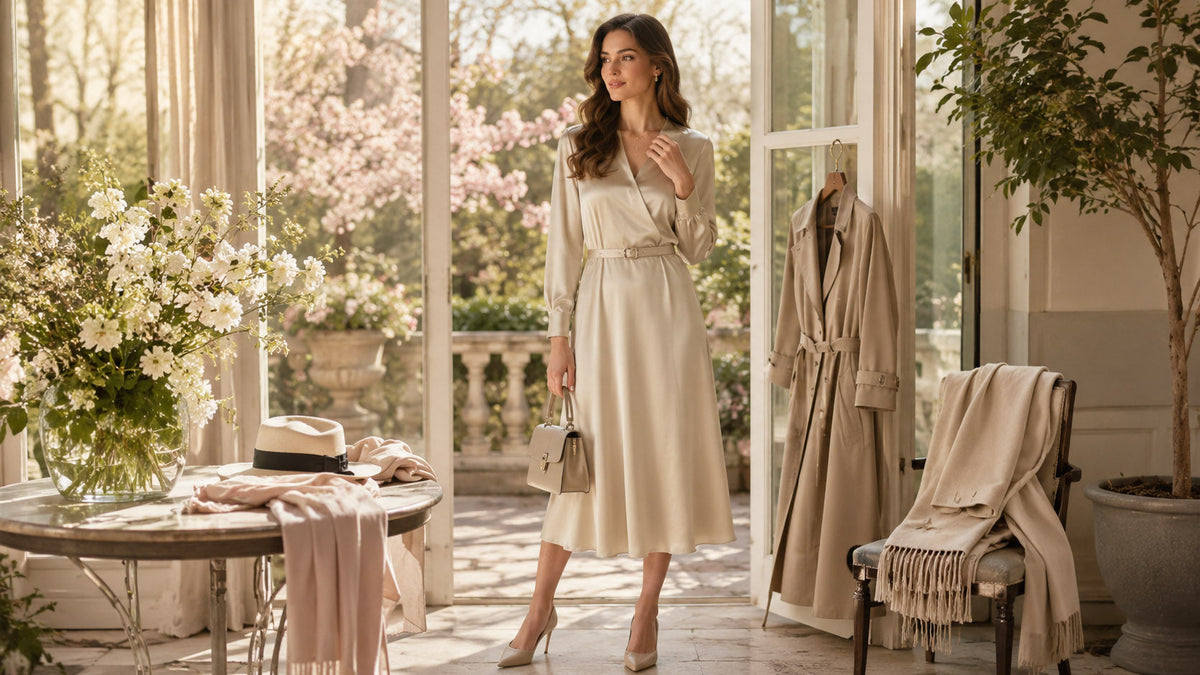
The most common misconception about a silk dress is that it belongs exclusively to summer. In fact, silk is one of the most temperature-responsive natural fibres available — it is as effective at providing warmth in cool conditions as it is at keeping you cool in heat. A silk dress is a year-round garment, and the women who wear theirs most often are those who have understood how to adapt it to each season rather than relegating it to three months of the year.
Wearing a Silk Dress in Spring

Spring is perhaps the most natural season for a silk dress. The temperatures are mild and variable — which is precisely where silk performs best — and the aesthetic energy of the season (lightness, movement, a sense of renewal) maps directly onto what a silk dress communicates. For spring, lean into midi and maxi silhouettes in botanical prints or soft, naturalistic tones. Layer with a fine knit cardigan or a lightweight trench coat that can be removed as the temperature rises through the day. Pointed flats or low mules complete the look without adding formality that the season does not call for.
The key spring consideration is the temperature swing between morning and evening. A layer that packs flat and weighs almost nothing — a fine scarf, a thin knit — allows the silk dress to be worn across a full day without discomfort as the temperature changes. The silk itself regulates naturally across this range; the layer manages the edges of the day.
Wearing a Silk Dress in Summer

In summer, silk outperforms every synthetic alternative in terms of comfort. Unlike polyester-based fabrics that trap heat against the body, silk allows air to circulate and moisture to move away from the skin. A silk dress worn in warm temperatures stays cooler longer and remains comfortable across a full day in a way that heavier or synthetic fabrics cannot match.
For summer, minimal layering is the goal. A slip dress or a loose midi in a breathable silk weight, worn with flat leather sandals and a woven bag, is one of the most genuinely comfortable combinations available for warm-weather dressing. In the evening, when temperatures drop, a thin linen layer or a light wrap is enough — the silk itself retains some warmth, making heavy additional layers unnecessary. For the specific question of summer comfort and silk, the detailed article on whether silk dresses are good for summer covers the full picture.
Wearing a Silk Dress in Autumn

Autumn is the season in which the layering potential of a silk dress is most fully realised. The same dress that was worn with minimal additions in summer becomes the central piece of a composed, multi-layered outfit as the temperature drops. A silk midi dress under a tailored coat in camel or stone, worn with ankle boots and a fine-knit roll neck beneath — this is one of the most considered and polished combinations available for the season.
For the roll-neck-under-silk-dress combination specifically: choose a very fine knit with a slim neck that fits cleanly inside the dress neckline, and ensure the sleeves are long enough to fill the arm of the dress without bunching. A bodysuit or fitted long-sleeve top in a thin jersey fabric is an alternative that avoids any bulk. The outer layer — coat, leather jacket, oversized cardigan — completes the layering and transitions the dress from a standalone summer piece into an integrated autumn outfit.
Transitional Dressing Tips
For the specific in-between days of early autumn, when temperatures are genuinely uncertain, a silk dress layered with a denim jacket and ankle boots is one of the most versatile and weather-agnostic combinations available. The denim adds a casual groundedness that removes any excessive formality from the silk; the boots manage cooler temperatures at the extremities. This combination works from a mild autumn day through an air-conditioned indoor environment and back again without any adjustment.
Wearing a Silk Dress in Winter

Winter silk dressing requires more deliberate layering, but the result — when achieved — is one of the most elegant cold-weather combinations in a woman's wardrobe. The foundation is a warm base layer beneath the dress: a fitted thermal or fine-knit turtleneck creates warmth without adding visible bulk. Over the dress, an ankle-length wool or cashmere coat in a neutral tone creates the full silhouette. Add thick tights or opaque stockings for leg warmth, and knee-high boots for foot and lower-leg coverage.
The key distinction between winter silk dressing done well and done poorly is the quality of the base layer and the length of the outer coat. A coat that falls short of the dress hemline creates an awkward proportion. A base layer that adds visible bulk through the bodice disrupts the clean line of the silk. Get both of these right, and the silk dress becomes one of the most refined pieces in a winter wardrobe.
Year-Round Care
Silk worn across all four seasons needs appropriate care at each transition. Allow silk to air between wears rather than rewashing after every use; store it hanging rather than folded where possible to avoid permanent creasing; and address any marks or stains promptly, as dried stains set more permanently in silk than in other fabrics. A hand-washed or delicate-cycle silk dress that has been cared for through all four seasons will look better at the end of the year than a synthetic alternative looks the first time it is worn. For more on making the most of a silk dress through each occasion and context, the complete silk dress styling guide covers every scenario.
