
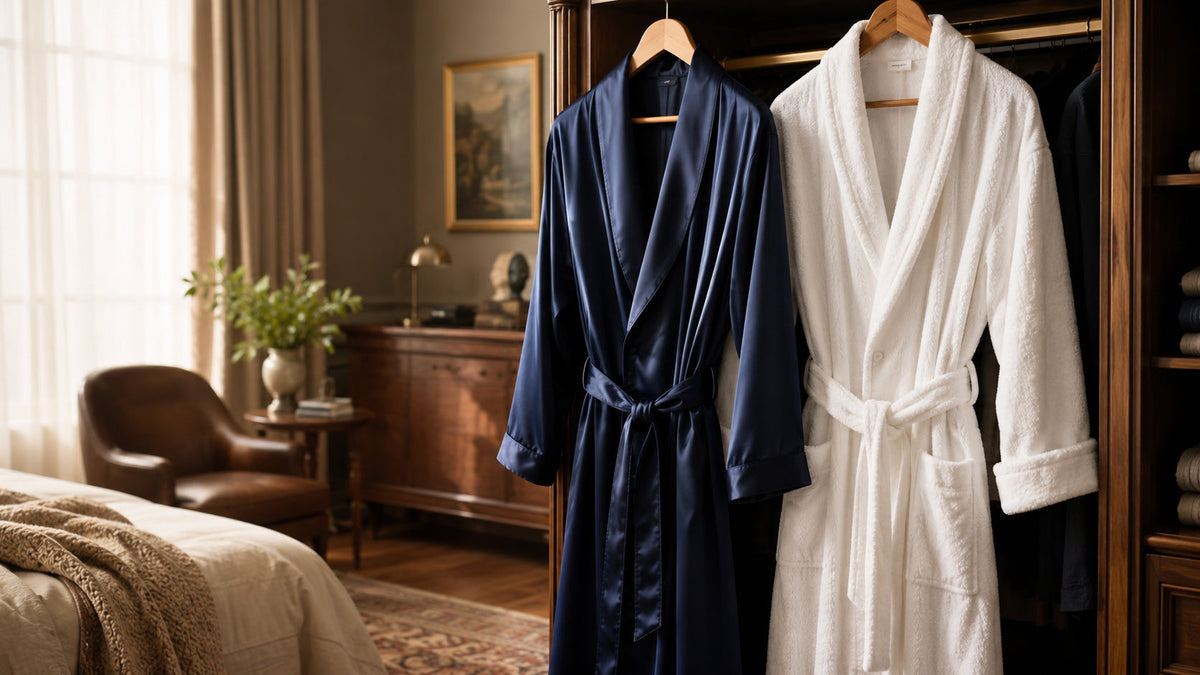
The question comes up more often than you might expect: is a silk robe genuinely better than a cotton one, or is it simply more expensive? The honest answer is that they are different objects serving different purposes — and understanding those differences makes the choice straightforward. What follows is a clear-eyed comparison of both materials across the factors that actually matter in daily use: feel, temperature regulation, durability, care, and long-term value.
The Feel Difference Is Immediate and Lasting

Cotton terry and cotton waffle weaves offer a certain kind of comfort — familiar, warm, and tactile in the way of a well-worn towel. Mulberry silk, by contrast, feels entirely different from the first moment of contact. It is smooth rather than textured, cool rather than warm, and it moves with the body rather than sitting on it. The drape of silk against freshly washed skin is one of those material experiences that is genuinely difficult to describe to someone who has not had it — and difficult to go without once you have.
Over time, cotton terry tends to pill and stiffen with repeated washing. Silk, cared for correctly, maintains its surface quality for years. The initial tactile difference grows into a long-term difference in how the garment holds up — and how it continues to feel across hundreds of mornings.
Temperature: Where Silk Has a Clear Advantage

Cotton terry is designed primarily for warmth and absorption — both of which are useful immediately after a shower but can become uncomfortable within twenty minutes of morning activity. Most men who wear terry robes find themselves overheated within half an hour, particularly in warmer months or centrally heated homes.
Silk Regulates Rather Than Insulates
Silk functions differently. Its protein structure allows constant airflow against the skin, regulating temperature naturally rather than trapping it. This means a silk robe remains comfortable whether the morning is warm or cool, and whether you are moving around the house or sitting still with a coffee. It is not a cold-weather insulator — for very cold mornings, layering over warm sleepwear is the right approach — but as an all-season garment, it outperforms cotton in almost every climate scenario.
Absorbency: The One Area Where Cotton Wins
It is worth being honest about this. Cotton terry is far more absorbent than silk, and if the primary function of your robe is to dry your body after a shower, a thick cotton robe will do that job more efficiently. Silk is not designed for rapid moisture absorption. It is designed for extended morning wear — for the time after you have already dried off, when you want to move through the first part of your day in something that feels considered and comfortable rather than heavy and damp.
This is the most important distinction to understand before choosing. If you are buying a robe purely as a post-shower towelling garment, cotton makes more sense. If you are buying a robe for the hour or two of your morning that belongs to you — coffee, reading, the slow start — silk is in a different category entirely.
Durability: A Question of Care
Cotton terry is more forgiving of rough treatment: high-heat machine washing, tumble drying, irregular care. It degrades gradually and tolerably. Silk requires more deliberate care — hand washing or a delicate cycle, air drying, gentle detergent — but when that care is given, a quality silk robe maintains its condition far longer than most cotton alternatives. The longevity gap between a well-cared-for silk robe and a frequently machine-washed cotton robe, measured over three to five years, is significant.
If the idea of hand washing a garment feels like an obstacle, it is worth pausing on that. The process takes under five minutes and becomes entirely routine within a few weeks. Most men who own silk robes describe the care ritual as less burdensome than they expected — and considerably less burdensome than replacing a cheaper robe every eighteen months.
Appearance and Presence

A silk robe looks different to a cotton one — and this matters more than it might initially seem. The natural understated sheen of silk gives a robe a presence that cotton cannot replicate. It is the difference between something you throw on and something you put on. Over time, this quiet distinction becomes part of how you experience your mornings: the robe that feels like an afterthought versus the one that signals, even to yourself, that the first hour of the day is worth inhabiting deliberately.
The Value Calculation
Silk robes cost more at the point of purchase. That is simply true. But the comparison becomes more nuanced when spread over time. A quality silk robe, cared for correctly, can last a decade or more with the same feel and appearance it had on the first morning. A mid-range cotton robe, washed regularly in a machine, tends to look and feel noticeably worn within two to three years. Measured as a cost per morning, the difference between the two narrows considerably — and at some point, inverts entirely.
The question is not really which robe is worth more money. It is what you want the first part of your day to feel like, and how long you want that to last. For more on keeping a silk robe in exceptional condition, the care guide covers everything you need. And if you are wondering how to wear a silk robe across different parts of your day, there is more on taking a silk robe beyond the bathroom.
The Honest Recommendation
If you want absorbency and do not mind replacing your robe every few years, a well-made cotton terry robe will serve you. If you want something that feels elevated every morning, regulates temperature across seasons, ages gracefully with minimal care, and makes the first part of your day feel like it belongs to you — silk is the only material that delivers all of that together. That is not a marketing claim. It is simply what the materials do.
